Live now…
Cache directory "/home/content/f/w/s/fwschmidt/html/wordpress/wp-content/plugins/ttftitles/cache" is not writable.New column
December 27th, 2010Cache directory "/home/content/f/w/s/fwschmidt/html/wordpress/wp-content/plugins/ttftitles/cache" is not writable.Hitting a religious nerve
December 23rd, 2010In a recent column written for the Washington Post, I commented on religious displays in public spaces. As is the case with articles of that kind, the Post went for a title that would match other contributions to the symposium that they were featuring. Their title for the article was “The Scandal of Atheist Campaigns against Christmas” and, predictably, it attracted a different audience.
The change in title was a bit unfortunate, because I’m not sure that there is a campaign against Christmas. That’s not what I argued. And, even if there is a campaign of sorts, I am not the least bit worried about it. The bigger challenge facing the church is not atheism or agnosticism, it’s the church’s own failure to believe deeply what it teaches at Christmas — and a fair bit of sloppy thinking about what that teaching even is.
But the visceral, vicious, and — at times — vulgar remarks made by some (not all) of the people who identified themselves as atheists did surprise me. So, I learned a few things about the American spiritual landscape.
One, conversations about atheism hits a religious nerve with some atheists and agnostics.
Two, some atheists and agnostics are just as religious about being agnostic or atheist as religious people can be.
Three, for all their protests that religion is a purveyor of animosity, evidently, atheists and agnostics can be just as rude and dismissive as religious people can be.
A colleague of mine noted that it reminded him of a bumper sticker he saw once: “Militant Agnostic on Board: I don’t know AND YOU DON’T KNOW EITHER!”)
So, what’s going on in the American spiritual landscape that includes militant atheists and agnostics?
A few observations:
One, there is a religious narrative of sorts imbedded in the atheist and agnostic position: There is no God. Science will eventually not only describe what goes on around us, but will explain it all. This journey will yield a rational world free of the violence and prejudice that plague our planet thanks to religious superstition. Christianity is the most evil religion that ever existed. And, although we are here by accident, we can live a meaningful, moral existence before we expire and our consciousness evaporates.
Two, people do not necessarily become atheists or agnostics for entirely rational reasons. Some do, perhaps, but as the word “atheist” implies — some arrive at their position in large part out of a reaction against religion. So, you can hit a religious nerve trying to talk to an atheist or agnostic — because they are evangelists for a point of view. In fact, one of the things that I discovered is that at least a few of them consider themselves the vanguard of a loose coalition devoted to the destruction of religion.
So here are questions to consider:
Can we really believe that violence and prejudice are traceable almost solely to religious belief?
Can we really believe that atheism and agnosticism are positions that are singularly more rational than the positions taken by people who are religious? Isn’t the assertion that we will know that there isn’t anything beyond our descriptive powers — in other words, proof of a negative — as much a faith-statement as is the assertion that there is a god?
Can we really believe that atheists and agnostics are less prone to narrow-mindedness, bigotry, arrogance, or the violence than are religious people?
Can science really free us? Is it free of ideology, agendas, and the potential for abuse? Can science really be explanatory as well as descriptive?
What is a meaningful existence? If we are here by accident and we are all bound for extinction, what are the limits to a meaningful existence in a world without God? What’s more, why should anyone feel bound by those limits?
Can we really be as confident (as some atheists and agnostics seem to be) that we would be better off in a world without Jesus, St. Francis, Buddha, Martin Luther King, Mother Theresa, Elie Wiesel, Confucius, Archbishop Desmond Tutu, Rumi, The Right Reverend Oscar Romero, Krishna, Moses, Ghandi, and countless others who have attributed the shape of their lives and the contributions they have made to a belief in God?
Cache directory "/home/content/f/w/s/fwschmidt/html/wordpress/wp-content/plugins/ttftitles/cache" is not writable.Something new for Christmas
December 21st, 2010One of my students recounted a story that, I’m told, is widely known in Roman Catholic circles. So the story goes: A little girl was sitting with her mother in church and asked,
“Mommy, where is Jesus?”
Deeply formed by her faith, the little girl’s mother pointed to the Tabernacle where the reserve sacrament is kept.
The little girl was silent for a moment and then declared,
“When I grow up I’m going to buy him a bigger box.”
This Christmas, consider getting something that cost you nothing, but may make all the difference.
Get a bigger box for Jesus.
Just what that might mean in your own life, I can’t tell you.
But you knew instantly —
Cache directory "/home/content/f/w/s/fwschmidt/html/wordpress/wp-content/plugins/ttftitles/cache" is not writable.God in public places
December 20th, 2010This column originally appeared in the Washington Post and was really less about atheism than it was about religious displays in public places. But the Post gave it a different name:
Cache directory "/home/content/f/w/s/fwschmidt/html/wordpress/wp-content/plugins/ttftitles/cache" is not writable.Gurus and Gods: On Spiritual Direction
December 16th, 2010 My students often bring things to my attention that stick. It’s one of the gifts of reading their papers. One of the students in our spiritual direction program noted that some clergy are suspicious of spiritual direction. She quotes one pastor who observes,
“I fear that the gift of so-called spiritual director is just another guru-gimmick which sources spirituality in religious opinions, teachings, and practices that are utterly foreign to Holy Scripture, and such a source of spirituality will not promote the unity of faith amongst believers, as does the legitimate gift of pastor-teacher, but a diversity of beliefs revealing that all the spiritual directors and listeners are being ‘tossed to and fro, and carried about with every wind of doctrine.’”
My student cited the author of this observation and I confess that I don’t know him. So, I have no way of knowing what his real motives or fears about spiritual direction might be. Here is what I hear, however:
One, uniformity of belief is an indication that someone is on the appropriate spiritual path. God only works in one way and variation is suspect.
Two, spiritual direction and spiritual directors operate by their own lights and they are unaccountable to Scripture.
Three, the only legitimate dispenser of spiritual wisdom is the pastor-teacher.
Here is what is wrong with the views expressed above:
One, uniformity of belief might be comforting to us, but God does not seem particularly concerned about it. There are undoubtedly core beliefs that are defining for Christians, but there is also some considerable variation in belief and — more importantly — experience. God can be pretty unorthodox.
Two some spiritual directors pay little attention to Scripture. But Christian directors do pay attention to Scripture. In fact, directors often use Scripture as a means of suggesting prayer practice and meditations for their directees; and some of the oldest traditions in spiritual direction (for example, the Ignatian approach) relies upon Scripture to frame its understanding of the spiritual life.
Three, the fact that someone is a spiritual director does not mean that they are worthy of your trust. But the same could be said about “pastor-teachers.” The issue is not title or calling. The issue is one of spiritual accountability.
Anyone who calls himself or herself a spiritual director but acts like a guru is not worthy of your trust. But the same could be said of a pastor-teacher who acts like God.
Cache directory "/home/content/f/w/s/fwschmidt/html/wordpress/wp-content/plugins/ttftitles/cache" is not writable.Why is the Incarnation important?
December 15th, 2010I’ve contributed an abbreviated answer to this question as part of a symposium at Patheos:
http://www.patheos.com/Resources/Additional-Resources/Why-the-Incarnation-Matters?offset=1&max=1
Check out the site and chime in.
Here is the rather longer version of the answer I gave:
From the beginning Christians have affirmed that Jesus is both fully God and fully human.
Why?
If Jesus is just a good guy, then the world has one more hero — but nothing more — and we are stuck with no way out. You can stack up martyrs like firewood (and many have), but while the example may change the behavior of a few, the world remains a broken, hopeless place.
If God had not bothered to tell us that we are beloved by entering into our lives, then we would have been stuck with the architect of the cosmos, living at a comfortable, divine arm’s length from our chaos. Nicely celebrated at the opening of Congress and football games, but no earthly good.
The incarnation says “no!” to both alternatives and it is important precisely because it does. Its message is one of hope and deliverance. God is different enough to be capable of saving us — enough like us to understand our needs.
That is why from the beginning Christians have also affirmed that God is both transcendent and immanent: different from us, free of our frailties and, at the same time, like us, deeply aware of our struggles, attuned to our needs, in our skin.
Some have focused on a transcendent god. Think angry old man in the sky — perfect, judgmental, clear about what a mess we are.
Faced with a god like that others have argued for an immanent god — someone like us, becoming, emerging, struggling. Think, screwed up just like us, only in charge of the cosmos.
A god who is only transcendent is incapable of loving us. A god who is just like us may care, but is incapable of delivering us.
A god who is both transcendent and immanent is the only kind of God who can help us: different enough to be capable of saving us — enough like us to understand our needs. Both are necessary to the Christian message.
Jesus is Emmanuel — God with us.
Cache directory "/home/content/f/w/s/fwschmidt/html/wordpress/wp-content/plugins/ttftitles/cache" is not writable.Always a pilgrim
December 14th, 2010 I had the privilege of addressing the “Gusto!” group at King of Glory Lutheran Church here in Dallas. As the description of the group might suggest, the class is largely (though not exclusively) made up of folks who have retired. And the subject that they wanted to explore dealt with God’s will.
One of the people who attended admitted that she really wasn’t sure that there was much for someone her age to gain from a conversation of that kind. But, thankfully, I did a bit of “profiling” and chose to answer the questions that I think most people have about the will of God at or around the age of retirement. I don’t have the full text here (though later I will post the recording).
But I can share, in brief, the six questions I raised for the group and the abbreviated form of the answers I gave:
i. Did I make choices that brought me to this place in life?
Yes. Many of us talk about having done the only thing we could do, or about God bringing us to this or that place in life. That’s understandable language, but when it suggests that we haven’t made any real choices or that we bear no responsibility for them, then something is amiss.
We may not want to take responsibility.
We may have too simple a vision of what it means for God to “be in control.”
But when we seemingly claim that God is completely responsible for the events in our lives, then we run the risk of erasing moral responsibility for our choices. And we also make nonsense of the spiritual gifts that we have been given. We are free and free to be creative. Part of the joy and privilege of being a child of God is the gift of choice.
Life is not paint by numbers — it is a blank canvas that God invites us to fill with color. And the reassurance given us is not that nothing happens that God doesn’t will — the reassurance is that God is with us.
ii. Did you make some wrong choices?
Yes. And you haven’t made your last one.
Mistakes lack moral content. They are often the by-product of a lack of information, growth in wisdom, experience, and education. “To err is human.”
When it comes to mistakes the important thing to remember is that “you know what you know when you know it.” Once you do, the only mistake you can make is to continue making the same mistake. Endless post mortems do neither you, nor the people you love any good.
Sin — the willful choice to ignore God — is a different matter. But even here, it is important to ask, “what do even sinful choices tell me about the needs of my soul.” Repentance and amendment of life is not about making us feel bad about ourselves, it is about restoring and repairing the depth of intimacy we enjoy with God and with others.
iv. Does it matter that I have made the wrong choices?
Not as much as you think. God’s providence is endlessly adaptive. Our conception of divine control is shaped by the simple metrics of human control…”If I am in control, then nothing happens that I don’t want to happen.”
But God gives us the gift of choice and can respond creatively and in ways that make for new possibilities even when we “get it wrong.”
In all likelihood, God is probably more often frustrated by our indecision than the choices we make — and all of them figure more importantly as an opportunity for getting to know God.
v. Do I have choices left and do they matter?
Yes. Age has nothing to do with the question of God’s will for us.
In the first place, discerning the will of God is not about us anyway. It is about cultivating an awareness of where, when, and how God is at work in the world. And that is a process that has nothing to do with our individual lives. In fact, there is something to say for the wisdom that someone older might bring to that process.
The prophets used to speak of “young men dreaming dreams and old men seeing visions.” Every generation has light to bring to bear on the effort to listen for God.
To the extent that our individual lives matter — and they do — the thing to remember is that the work of God in our lives is not about the things we do — never mind the things we do early in life. They are about the person we are becoming. And the choices we make shape that becoming over a lifetime.
That is why it is far more important to ask, “Who am I before God?” than it is to ask “What does God want me to do?”
God loves you better than you love yourself and you were meant for glory.
Cache directory "/home/content/f/w/s/fwschmidt/html/wordpress/wp-content/plugins/ttftitles/cache" is not writable.Forming Clergy or Credentialing Cheats
December 13th, 2010Thoughts from the end of a semester:
http://www.patheos.com/Resources/Additional-Resources/Forming-Clergy-or-Credentialing-Cheats.html
Cache directory "/home/content/f/w/s/fwschmidt/html/wordpress/wp-content/plugins/ttftitles/cache" is not writable.What do you need to hear?
December 11th, 2010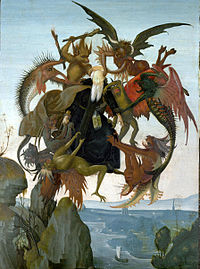 My wife and I recently spent a day at the Kimbell Museum in Fort Worth. In the permanent collection is what may well be Michelangelo’s earliest painting, “The Torment of St. Anthony” — a vivid portrayal of St. Anthony’s struggle with temptation in the desert. It got me thinking…
Our inner lives are too small.
They are cluttered with the kind of distractions that they sell in tourist traps — pot metal and plastic, cheap construction, loud colors — here today, gone tomorrow, about to be replaced by more of the same.
And when our inner lives are not made small by the countless distractions that clutter them, then our inner lives are often crowded with fears — large and small, biting at our necks, pulling at our sleeves — like St. Anthony’s tormentors in Michelangelo’s painting.
What a shame — because God’s gentle, quiet, open invitation is to listen and respond. What are the deepest needs of your soul? What do you need to hear? What kind of clutter keeps you from hearing it?
Cache directory "/home/content/f/w/s/fwschmidt/html/wordpress/wp-content/plugins/ttftitles/cache" is not writable.Therapy and spiritual direction compared
December 8th, 2010In the certification program that we offer at Perkins one of the questions we explore are the differences between therapy and spiritual direction. The distinctions are important — both as a means of defining the boundaries between the two endeavors and as a means of further defining the nature of direction. If you are a spiritual director, or you are a directee, I invite your thoughts about the following comparisons and your own thoughts on the subject:
Therapy is specific in its focus.
Spiritual direction is comprehensive.
Therapy is problem-centered.
Spiritual direction is growth centered.
Therapy is devoted to managing and coping with life’s problems.
Spiritual direction is devoted to intimacy with God.
Therapy can cure.
Spiritual direction begins the process of healing.
Therapy is preoccupied with this world.
Spiritual direction is preoccupied with life in this world and the next.
Therapy can be done effectively without attending to the spiritual.
Spiritual direction cannot be done without attending to both the emotional and the spiritual.
Therapy can be done effectively without asking why we are here.
Spiritual direction begins with asking why we are here.
In therapy the practitioner listens to the client.
In spiritual direction, the director and directee both listen to God.